
Hinge-Weather: In conversation with Sven Birkerts, (17)
Danuta's Flights


“… each torpid turn of the world leaves such disinherited children.” — Rilke
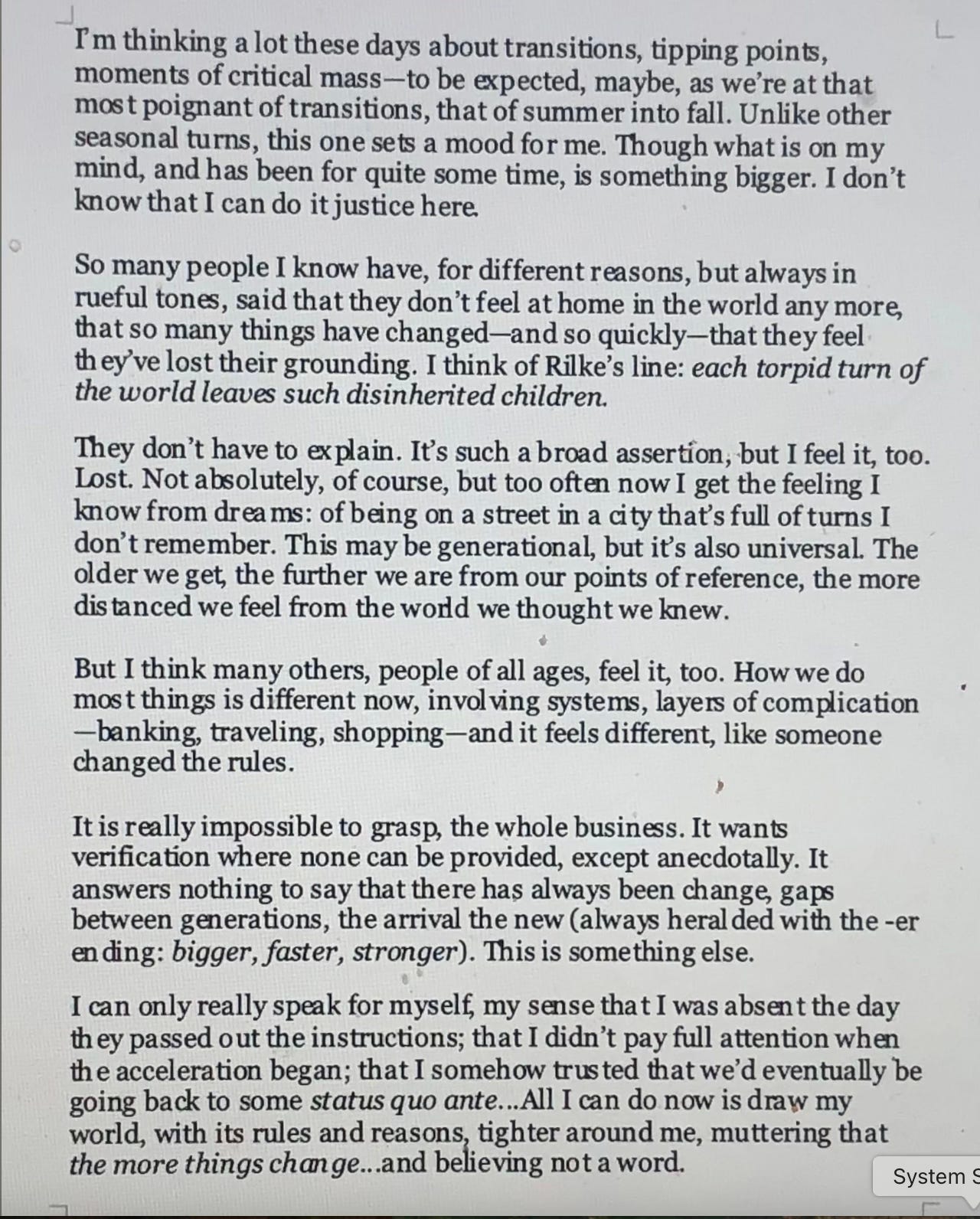
I know the year’s hinge-weather, the tilt from summer into fall when the air takes on a mood of ending and the light withdraws a half-step, as if to make room for thinking. The undertow of that turn can unhome the familiar, as though a city kept its street names but altered the order of its turns. I read Rilke’s line—each torpid turn of the world leaves such disinherited children—and I nod. My reflection begins where my “instruction manual” was first issued in a small stucco house in Poland that rehearsed motion without ever relocating, a place which taught me that when the rules change, the room can be redrawn.
We moved a lot without ever moving house. In our home, itineraries were argued into existence at the kitchen table or delivered by chance, and childhood required no comparative “elsewhere,” only variety. We made a country of its landmarks: the Tatry Mountains taught scale and the perspective of vastness; Morskie Oko Lake held mystery and magnificence in the very air around it; in the Wieliczka mines I saw darkness quarried into light, salt turned to translucent architecture; in Częstochowa the Black Madonna made devotion legible as both surface and depth. In the Warsaw Opera House, where Halka bound hundreds into a single attention, I felt myself belong to the crowd without losing autonomy. My mother leaned to whisper, “Look at the stage, not the people.” I answered, “I like looking at the people.”


This was not tourism per se, it was curriculum. If the world now feels denser with systems—banking, travel, shopping—all nested in unseen code, my first training for such opacity arrived early in my life. Part of it was domestic, a household that practiced thresholds and arrangement. The other part was political, a regime that ruled our days and taught the reality of limits.
The “something else,” is not simply the old relay of “bigger, faster, stronger.” I agree. The velocity of change is abstract now. The instruction sheet is a scroll of permissions and passwords that never quite unrolls. But the day they “passed out the instructions,” I was present, only the page looked like furniture.
My mother would periodically move the full-width wall unit to the opposite side of the living room as if translating a sentence into another language, recomposing shelves and cabinets until perception shifted. For a week, sometimes longer, the room existed in double architecture, the present overlaid by its predecessor, so that walking from door to window meant passing through a palimpsest where past and present somehow held. That was the instruction—"when the map refuses you, redraw the room.” The rule still holds on screens, in cities, and in the mind when the interface won’t explain itself.
One itinerary began with an accident. I was six. A car from East Germany struck a tree outside our house. Luckily, all three passengers survived. Edith—unbelted, as was common then—went through the windshield and spent a month in the hospital. My parents folded Helmut and his sister-in-law into our small house. Hospitality became kinship, and kinship a corridor. After that came annual journeys to Berlin—never “East Berlin” in our vocabulary, simply Berlin. Detlef, their son, was a year older. Our first common language was not German or Polish but bicycle bells, dice, the declarative clarity of laughter. From him I learned that every crossing is also a translation.


Once, riding his bicycle’s back rack, I attempted to govern our speed with my new words. Wanting slow, I shouted schnell, (instead of lángsam) and Detlef, obedient and surprised, accelerated until we rattled home, and I learned that in motion the wrong word is not an error but a direction. If the present leaves us feeling unbriefed, it may be because translation has replaced travel as the defining motion. The pace is set by how accurately we name what we are doing. To misname is to be sped up against our will.
In the larger reality of Poland’s 1970s–80s politics, a reality I could not fully read as a child or even as a high-schooler, the adults around me did not live linear lives from dawn to dusk. They navigated a maze, a choreography of stalls and surges, circles that repeated, sudden accelerations, outcomes never guaranteed. Some weeks the cupboards filled as if by providence—coffee, citrus, a coil of sausage—the quiet proof of luck, strategy, or a discreet connection. Other weeks the answer at the counter was the national refrain, dzisiaj nie ma, not today, offered without explanation, as if the day itself had been withheld.
Yes, the older we get, the more our points of reference recede, as if the world we thought we knew were stepping back to test our focus. For me that recession took the form of languages, each one loosening and retying the coordinates. First there was Kashubian dialect, heard at the market and in doorways, a music I was told not to notice—dismissed as backward, uncivilized—so I learned, early, that a government can outlaw not only words but attention. Then the occasional German of my parents, a private corridor between rooms. Then the compulsory Russian, and later the chosen studies of French, English, Latin. Each arrived with its own resistances— grammar that ran cross-grain to instinct, sounds the mouth hesitated to house, idioms that refused to be domesticated.
The only way through was invention. If I could not say a thing directly, I said it differently, letting accuracy emerge from detour. Translation became not a straight line but meandering, a string pulled by a playful cat, sometimes Ariadne’s thread, sometimes a mischief that led me past the obvious toward what I actually meant. I began to understand that paraphrase means meanings are carried across by care, not by force. With every new tongue, the distances widened and, paradoxically, I felt more at home inside them, as if language were teaching me how to live at the edge of what I can name—patiently, attentively, willing to be changed by the route.
There is one place where this all becomes testable. It is my classroom. I don’t feel disinherited by change so much as stunned by it—amazed, yes, and a little afraid—and the startle has become its own lesson plan. My students arrive fluent in the present. I arrive carrying the before—card catalogs and quiet libraries, paper maps and handwritten letters, the long pause between asking and knowing. Together we inventory the gains—speed, reach, access—and the collateral we are in danger of spending—patience, privacy, depth. The conversation itself becomes a bridge. Their native quickness meets my detailed thoroughness, and in the middle, we practice a shared craft we call “seeing differently.”
Some days, looking back, I think I was raised by motion—a patterned turbulence. Perhaps that is why I feel at home within change. The present asks something of me: attention as discipline, translation as ethics, a willingness to keep learning in public. Amazement leads; fear keeps me open and honest. What I can anchor, I anchor by sharing what I learn as I learn it, knowing that today’s instruction may not fit tomorrow’s weather. The hinge gathers itself before it swings.
Thinking about verification, proof beyond anecdote that the present’s alienation is not merely generational drift, I cannot verify, but I can testify. The Baltic Sea was the background of my life in Poland and it taught recurrence without sameness. Each wave returns but is not the same wave. The horizon offered promise and boundary in one clean stroke. These are not quaint memories. They are operating instructions for a world that confuses information-at-speed with knowledge. When the newness comes with an “-er” ending, I listen for the adverbs I often neglect, more carefully, more answerably, more together.
Does it feel like someone changed the rules? Yes. But rules are often only the latest arrangement of the room. A website, like a cabinet in a wall unit, can be re-sorted until it discloses itself. In Poland, we practiced small sovereignties, centimeter politics, because the large ones were denied. That practice made thresholds less frightening. They literally became teachers. I think, I meet today’s layered systems the same way. Not with faith in seamlessness, but with a willingness to unravel the seam.
Author’s Note. At Bennington MFA workshops, Sven Birkerts’ writing taught me to read thresholds, to let a sentence cross from perception to meaning without hurry, to keep the world inside the syntax. His essays have been my companions, reminders that thinking is a form of care. Lately I’ve been teaching his The Miró Worm and the Mysteries of Writing, and I watch students follow its quiet amazement as it tunnels through habit toward a clearer view. This dispatch is my reply to his recent meditation on season and the sense that “someone changed the rules,” but it’s also a reply to his longer influence—write so that attention becomes shareable, learn in public, keep faith with complexity. I offer this piece in gratitude for the questions he’s kept alive in me and now, through my classroom, in others.
 | A guest post by
|
Your experience made you deft at rearranging the furniture. Mine turned me toward nostalgia, the idea that, in Kundera's phrase "Life is elsewhere." I guess this relates to writing in that the elsewhere has migrated within.
An interesting read-----and gratitude for the nice words...
Thank you for your words, both of you.